By DAV Editorial Team · Last updated: February 2026
For families living in Lalitpur, the school decision carries a particular weight. Patan is one of the most culturally significant cities in the Kathmandu Valley, with a heritage that stretches back centuries and a community that values depth, quality, and character. Parents here do not simply want a school that produces exam toppers. They want an institution that understands what a well-rounded education actually looks like.
DAV Sushil Kedia Vishwa Bharati School, established in 1993 in Jawalakhel, has been that institution for thousands of Lalitpur families over the past three decades. With more than 3,000 students, 500 faculty members, and an ISO 9001:2015 certification, DAV has built a reputation that goes well beyond its test results. This article explains specifically why DAV stands as the best school in Lalitpur, focusing on what makes it the right choice for families who live in and around the city.
A Location That Works for Lalitpur Families
Geography matters enormously in school selection, and DAV's position in Jawalakhel is one of its most practical advantages. Jawalakhel sits at the heart of Lalitpur, making it accessible from a wide range of neighbourhoods without the long commutes that sending a child to central Kathmandu often requires.
Below are approximate travel times from key areas in and around Lalitpur:
The school operates 78 bus routes across the valley, with student-friendly services designed around punctuality and safety. For working parents, this reliability is not a convenience but a necessity. Knowing your child will arrive and return on a consistent schedule, without the unpredictability of relying on public transport, removes one significant source of daily stress.
Beyond convenience, the Jawalakhel location places students in one of the most culturally rich environments in Nepal. The campus sits within easy reach of Patan Durbar Square, the Patan Museum, Krishna Mandir, and other UNESCO World Heritage Sites that shape Lalitpur's identity. DAV builds this proximity into its educational model through regular excursions and field trips, helping students connect what they learn in the classroom to the living history around them.
A Campus Designed for Serious Learning
DAV's 34-ropani campus in Jawalakhel is one of the largest school campuses in the Kathmandu Valley. Size alone means little, but what the school has built on that land reflects a clear commitment to creating the conditions where serious learning can happen.
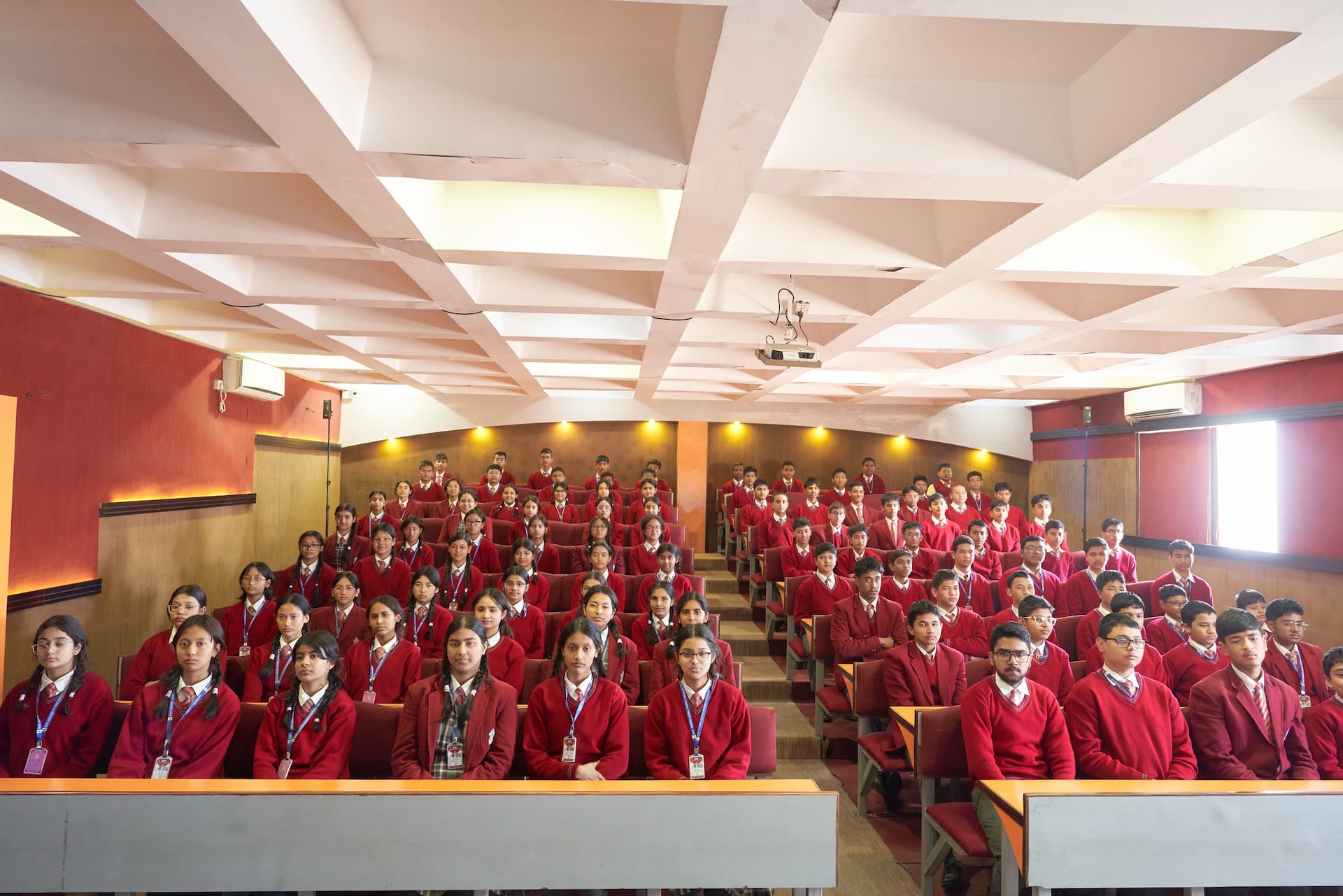
Classrooms are spacious, accommodating 35 students each, with proper ventilation and natural light. From Grade 9 onwards, classrooms are equipped with interactive smartboards. Science laboratories cover Physics, Chemistry, and Biology to full practical examination standards. A dedicated language laboratory supports the school's multilingual programme. The library provides access to reference books, educational resources, and e-learning platforms.
For larger gatherings, the campus includes five auditoriums: Buddha Hall (700 seats), Indu Auditorium (400 seats), Pratik Hall (250 seats), Jetavan Hall (200 seats), and Dhamma Hall, a 40-seat space dedicated to Vipassana practice. These facilities support the school's full calendar of cultural programmes, competitions, and community events throughout the year.
The sports infrastructure is equally serious: a full football ground, futsal court, cricket ground, indoor cricket facility, basketball court, volleyball court, and table tennis hall. Students do not share facilities or wait for access. Physical education is treated as a genuine part of the curriculum, not a timetable filler.
Academic Pathways That Keep Options Open
DAV School is affiliated with both CBSE (Central Board of Secondary Education, New Delhi) and NEB (National Examination Board, Nepal), which means families are not locked into a single academic pathway. Students at the lower secondary level choose between the two curricula based on their goals and circumstances, and this choice can be revisited as those goals evolve.
At the higher secondary level, students specialise in either the Science stream (English, Physics, Chemistry, Mathematics or Biology, Computer Science, Home Science) or the Commerce stream (English, Accountancy, Business Studies, Economics, Mathematics or Computer Science, Physical Education, Home Science). CBSE credentials are widely recognised by universities in India, the UK, Canada, Australia, and across Southeast Asia, giving DAV graduates genuine flexibility when applying for higher education.
From Grades 6 to 9, vocational subjects including IT, electricals and electronics, fashion designing, mass media studies, banking, and health science run alongside the academic curriculum. These are not peripheral options. They are structured programmes that give students practical skills and an early understanding of what different career paths actually involve.
The school's multilingual programme offers Chinese, French, German, Hindi, Pali, and Sanskrit in addition to English and Nepali. For students in Lalitpur who grow up in a culturally layered environment, the ability to operate confidently in more than one language is a natural extension of the world they already inhabit.
DAV's CBSE and NEB dual-board model means parents do not have to choose between a nationally recognised qualification and international university access. Their child can have both.
Lalitpur's Cultural Identity in the Classroom
One of the less obvious but genuinely significant advantages of a school rooted in Jawalakhel is the way Lalitpur's culture can become part of the education itself. DAV takes this seriously.
Students take educational trips to Patan Durbar Square, local temples, and heritage sites as part of their social studies and cultural education. These are not reward outings. They are integrated into the curriculum as a way of building historical literacy and local identity alongside the international perspective that the school works hard to develop.
This balance reflects DAV's founding philosophy: "Eastern hearts and Western minds." The school does not ask students to choose between their cultural roots and global ambition. In Lalitpur, where Newari heritage, Sanskrit scholarship, and contemporary professional life coexist naturally, that philosophy resonates particularly well.
Holistic Development: Beyond the Report Card
DAV's approach to student development extends well beyond academic performance. Daily Anapana meditation during morning assembly builds focus, emotional regulation, and the kind of patience that academic pressure often erodes. Yoga has been a part of the school's routine since its founding in 1993, long before it became fashionable in educational settings.
The school runs 16 active student clubs, including the Newton Science Club, Mayur Dance Club, Nat Kaji Music Club, Mother Teresa Social Service Club, Vasudha Eco Club, and Friends of Zoo Club. These are not nominal organisations. Each runs its own programme of activities, projects, and events across the academic year.
Six houses (Annapurna, Dhaulagiri, Gaurishankar, Kanchenjunga, Lhotse, and Machhapuchhre) organise students into teams that compete across debates, quizzes, sports, and cultural events. The house system builds loyalty, healthy competition, and the experience of belonging to something larger than the individual classroom.
Sports coaching covers cricket, basketball, football, taekwondo, gymnastics, and martial arts. Recent achievements include wins at the Jugal Nawa Gurukul Taekwondo Championship in 2025 and international football representation at a trip to Denmark the same year. These are not isolated results. They reflect a consistent culture of competitive participation across disciplines.
Safety and Environment
The campus operates 24-hour security with CCTV surveillance and Group Four security teams managing entry and exit. Discipline at DAV is not enforced through fear or punishment but developed through expectation and example. Uniforms, punctuality standards, and clearly communicated conduct guidelines create a structured environment where students know what is expected and why.
The on-campus infirmary provides regular health check-ups, wellness camps, and immediate first aid. The 100% vegetarian canteen serves fresh, nutritious meals daily. For families considering the hostel, boarding students receive the same structured daily routine of meditation, yoga, meals, and sports within a supervised and secure residential environment.
Parent communication is supported through digital dashboards, a dedicated mobile app launched in 2018, and regular orientations that keep families informed and involved. The school's Family Jamboree is one of several annual events designed to bring the parent community together and maintain the relationship between home and school that good education depends on.
Recognition and Track Record
DAV holds the distinction of being Nepal's first ISO 9001 certified school. Its formal recognitions include the International Goldstar Award (2013), Mother Teresa Excellence Award (2013), Glory of India Award (2013), and the Youth Ambassador for Peace recognition (2008 to 2009). In 2025, the school received a Certificate of Appreciation from Mansha Foundation Nepal for charitable contributions and hosted the 19th World Sanskrit Conference, one of the most significant academic events in the region that year.
The alumni association HISSA connects over 15,000 graduates, including professionals working in leading universities, Fortune 500 companies, public institutions, and entrepreneurial ventures across multiple continents. The strength of an alumni network is one of the most honest signals of what a school actually produces. DAV's network is active, global, and genuinely accomplished.
Frequently Asked Questions
Yes. DAV's Jawalakhel campus is reachable within 15 to 20 minutes from most parts of Lalitpur, including Patan, Pulchowk, Kupondole, Lagankhel, and Sanepa. The school operates 78 bus routes across the Kathmandu Valley, covering both Lalitpur neighbourhoods and areas in Kathmandu.
Yes. DAV is affiliated with both CBSE and NEB, giving students and families a genuine choice between national and internationally recognised curricula. The school's admissions team can help families decide which pathway best suits their child's goals.
Yes. DAV operates a well-managed hostel with 24-hour security, a vegetarian cafeteria, yoga and meditation spaces, sports facilities, laundry services, and supervised study time. Many boarding students come from districts across Nepal and from neighbouring India.
DAV accepts students from Nursery through to Grade 12, with Science and Commerce streams available at the higher secondary level. College-level programmes including BBA, MBA, and BSc CSIT are also available on campus.
Applications can be submitted online via davnepal.com. The process includes submission of required documents (birth certificate and previous academic records), followed by an entrance assessment and interview. The admissions team is available to guide families through each step.
Visit DAV Sushil Kedia Vishwa Bharati School
DAV is located in Jawalakhel, Lalitpur, Nepal. Guided campus tours are available for prospective families. To enquire about admissions, fees, or hostel availability:
- Hotline: 980-208-1010
- Phone: 01-5436626
- Email: school.admin@davnepal.com
- Website: davnepal.com
- Location: Jawalakhel, Lalitpur (find on Google Maps)
- Social Media: @davskvb_school on Instagram and @DAVSKVBSCHOOL on Facebook